








- Why Fuel Type Is the Biggest Decision
- Gas Range Cookers Explained
- Induction Range Cookers Explained
- Dual Fuel Range Cookers Explained
- Side-by-Side Comparison
- Energy Efficiency and Running Costs
- Cookware Compatibility
- Installation Requirements
- Future-Proofing Your Kitchen
- Which Fuel Type Should You Choose?
Why Fuel Type Is the Biggest Decision
When you start shopping for a range cooker, colour and size tend to grab the attention first. But the decision that will affect your cooking experience more than anything else is the fuel type. The decision of gas, induction or dual fuel shapes everything. How quickly your hob responds, how much your cooker costs to run, what pans you can use and even what installation work your kitchen needs.
It is a decision worth getting right, because a quality range cooker is a long-term investment. The brands we work with at Quince & Cook, (Bertazzoni, Lacanche, AGA and Everhot to name a few) build cookers that last for decades. Choosing the right fuel type at the outset means you will enjoy cooking on it for years rather than wishing you had gone the other way.
This guide explains what each fuel type actually does, how they compare on the things that matter most, and which option tends to suit different households and cooking styles. If you want to browse the full selection while you read, you can find all of our range cookers here.
Gas Range Cookers Explained
Gas range cookers use a natural gas or LPG supply to power both the hob burners and the oven. They are the traditional choice, and many experienced cooks still consider gas the gold standard for hob cooking. The flame provides instant, visible heat that responds the moment you turn the dial, making it intuitive to adjust from a rolling boil to a gentle simmer.
On the hob, gas gives you a level of tactile control that many cooks find difficult to replicate with other technologies. You can see the flame, gauge the intensity at a glance and make fine adjustments without waiting for an element to heat up or cool down. Techniques like charring, flambeing and wok cooking are naturally suited to an open flame.
The oven side is a little different. Gas ovens tend to produce a slightly moist heat, which can be excellent for roasting but less ideal for baking, where a drier, more even heat often gives better results. Temperature consistency can also vary depending on the model, with some gas ovens running hotter at the top than the bottom.
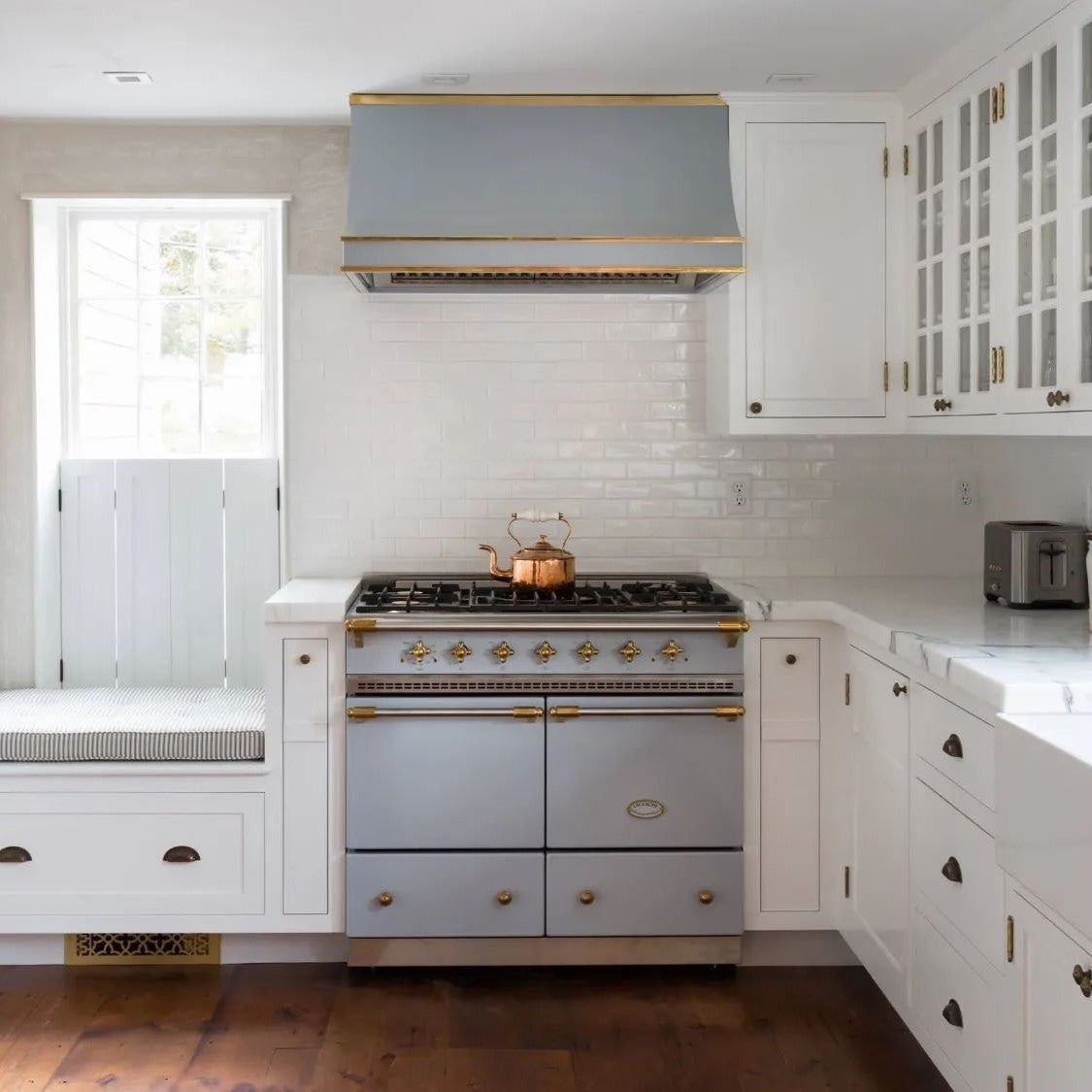
Gas range cookers are available from several of the brands we stock. Lacanche and Rayburn are two of the most respected names for full gas cooking, while Bertazzoni offers gas hob configurations in both their Master and Professional series. If you are drawn to a fully customisable gas setup, Lacanche allows you to specify everything from the number and size of burners to additional elements like chargrills and planchas.
Best suited to: Cooks who love the responsiveness and visual feedback of an open flame, households that already have a gas supply, and anyone who prioritises hob cooking over baking.
Induction Range Cookers Explained
Induction range cookers use electromagnetic fields beneath a ceramic glass surface to generate heat directly within the pan itself. Unlike gas or conventional electric hobs, the cooking surface does not get hot on its own. Instead, the magnetic field causes the metal in your cookware to heat up, which means energy goes straight into the food rather than being lost to the surrounding air.
The result is remarkably fast and precise cooking. Induction hobs can bring water to a boil significantly faster than gas, and they respond almost instantly when you adjust the temperature. That rapid response, combined with very precise low-temperature settings, makes induction excellent for tasks that demand control, such as melting chocolate, simmering sauces or maintaining a steady temperature for long reductions.
Because the hob surface stays relatively cool (it warms slightly from contact with the hot pan, but nowhere near as hot as a gas burner or ceramic hob), induction is also the safest option. There is no open flame, and most induction hobs will not activate unless they detect compatible cookware on the surface. Cleaning is simple too, since spills do not bake onto the flat glass top the way they do around gas burner grates.
Induction range cookers are paired with electric ovens, which tend to provide very even, consistent heat. This makes them a strong choice for bakers who need reliable temperature accuracy. Several of the brands at Quince & Cook offer induction options. Bertazzoni includes induction hob configurations across their range, and Lacanche can be specified with induction zones as part of a custom hob layout. The Everhot 90i and 110i also feature built-in induction hobs alongside their cast iron hotplates, giving you both traditional heat storage cooking and modern induction in one appliance.
Best suited to: Households that want speed and energy efficiency, families with young children who need a safer hob surface, keen bakers who value even oven heat, and kitchens without a gas supply.
Dual Fuel Range Cookers Explained
Dual fuel range cookers combine a gas hob with an electric oven, aiming to give you the best of both worlds. You get the instant flame control and tactile feel of gas burners on top, paired with the dry, even heat distribution of an electric oven below. This combination is the reason dual fuel is often described as the professional's choice, and it is one of the most popular configurations for premium range cookers in the UK.
The gas hob delivers everything discussed in the gas section above: visible flame, instant response, and compatibility with all cookware types. Underneath, the electric oven uses heating elements and often a fan-assisted convection system to circulate hot air evenly around the cavity. This matters most for baking, where consistent temperature throughout the oven means you do not need to rotate trays halfway through, and for roasting, where even heat helps achieve a uniform result.
Most of the Bertazzoni conventional range cookers available at Quince & Cook are dual fuel. The Professional and Master series both offer dual fuel configurations from 60cm up to 120cm, and the cookers include features like triple-glazed doors, programmable timers and multiple oven functions. The AGA Masterchef Deluxe is another well-regarded dual fuel option, combining a five-burner gas hob with accurate electric ovens. Lacanche can also be configured as dual fuel, with gas burners on top and electric ovens below, and you can mix and match oven types across the different cavities.
Best suited to: Cooks who want flame control on the hob and precision in the oven, households that bake and roast regularly alongside stovetop cooking, and anyone who wants the versatility to handle any recipe confidently.
Side-by-Side Comparison
The table below summarises how the three fuel types compare across the factors that matter most when choosing a range cooker.
| Gas | Induction | Dual Fuel | |
|---|---|---|---|
| Hob heat source | Open gas flame | Electromagnetic (heats pan directly) | Open gas flame |
| Oven heat source | Gas | Electric | Electric |
| Hob responsiveness | Instant, visible flame | Near-instant, very precise | Instant, visible flame |
| Speed to boil | Moderate | Fastest | Moderate |
| Oven consistency | Good (can have hot spots) | Very even | Very even |
| Best for baking | Adequate | Excellent | Excellent |
| Energy efficiency | Lower | Highest | Mixed (efficient oven, less efficient hob) |
| Safety | Open flame, requires ventilation | Cool surface, auto-off if no pan detected | Open flame on hob, standard oven safety |
| Cookware | Works with all types | Must be magnetic (cast iron, most stainless steel) | Works with all types |
| Cleaning | Grates and burner caps need regular cleaning | Flat glass surface, easy wipe-down | Grates on hob, standard oven cleaning |
| Installation needs | Gas supply only | Suitable electrical supply only | Both gas and electrical supply |
Energy Efficiency and Running Costs
Energy efficiency is an increasingly important factor in the UK, and the three fuel types differ meaningfully here. Induction is the most efficient technology available. Because the electromagnetic field heats the pan directly rather than the air around it, very little energy is wasted. Industry figures suggest induction hobs convert around 84% of their energy into usable cooking heat, compared with roughly 40% for gas. That difference adds up over months and years of daily cooking.
Electric ovens, which feature in both induction and dual fuel range cookers, are also more efficient than gas ovens. They benefit from better insulation and fan-assisted circulation, and they hold temperature more consistently, which means shorter preheating times and less wasted energy during cooking.
Gas remains a common choice partly because the per-unit cost of gas has historically been lower than electricity in the UK, which can offset some of the efficiency gap. However, the price difference has narrowed in recent years, and households with solar panels or renewable energy tariffs may find that an all-electric or induction setup is noticeably cheaper to run overall.
For a deeper look at which models offer the best balance of performance and efficiency, our guide to the most energy efficient range cookers compares specific models across brands. If energy use is a top priority for you, it is also worth reading about the eco-friendly advantages of range cookers, which covers how different technologies are evolving to reduce their environmental impact.
Cookware Compatibility
This is the one practical catch with induction that trips people up. Induction hobs require cookware with a magnetic base, which means it must contain iron. Cast iron, carbon steel and most stainless steel pans work perfectly. Aluminium, copper and glass cookware will not work on induction unless they have an induction-compatible base built in.
A quick way to check your existing pans is to hold a magnet to the base. If it sticks, the pan will work on induction. If you are planning a kitchen with an induction range cooker and need to replace some pans, this is a one-time cost that most people absorb easily.
Gas and dual fuel cookers have no restrictions at all. Any pan that can go on a flame will work, which means your full existing collection carries over without any changes.
Installation Requirements
Installation is worth thinking about early, because it can influence which fuel type is realistic for your kitchen.
Gas range cookers need a gas supply, either mains natural gas or a connection to an LPG (bottled gas) tank. Installation must be carried out by a Gas Safe registered engineer. If your kitchen already has a gas supply, the connection is relatively straightforward. If not, running a new gas line can be a significant additional cost.
Induction range cookers require a suitable electrical supply. Most range cookers need a dedicated circuit, and larger models may need a higher-amperage connection than a standard plug socket provides. Some smaller models, like the Everhot 60, run on a standard 13-amp plug, which makes installation much simpler. A qualified electrician should assess your existing wiring before you buy to confirm whether any upgrades are needed.
Dual fuel range cookers need both a gas supply for the hob and an electrical connection for the oven. This means you need both a Gas Safe engineer and potentially an electrician, and your kitchen must have access to both gas and electricity in the right location. For many UK homes that already have both services, this is not an issue, but it is worth factoring in if you are building or renovating a kitchen from scratch.
Whichever fuel type you choose, proper ventilation is also important. Gas cooking produces combustion gases and moisture, so an extractor hood or adequate kitchen ventilation is essential. Even with induction, a good extractor helps manage steam and cooking odours. You can find out more about extraction options on our ventilation page.
Future-Proofing Your Kitchen
It is worth thinking about where kitchen technology is heading when you invest in a range cooker that will last ten, twenty or even thirty years. The UK has committed to phasing out gas boilers in new-build homes, and there is a broader trend toward electrification across the household. While there are no current plans to ban gas cookers in existing homes, the direction of travel is clearly toward electric and induction cooking.
If you are building a new kitchen or doing a major renovation, choosing induction or a dual fuel setup with an eye on eventually switching the hob gives you more flexibility down the line. Some brands, like Everhot, already offer fully electric range cookers that can integrate with solar panels and smart energy tariffs, making them a genuinely future-ready choice.
That said, gas is not going anywhere in the immediate future for existing homes, and premium gas and dual fuel range cookers from brands like Lacanche and Bertazzoni are built to last well beyond any foreseeable policy changes. If gas is your preferred way to cook, there is no reason to avoid it.
Which Fuel Type Should You Choose?
There is no single right answer here, because the best fuel type depends on how you cook, what your kitchen can accommodate and what matters most to you. But after years of helping customers make this decision, here is how we tend to think about it.
Choose gas if you are an experienced cook who loves the responsiveness of a flame, you already have a gas supply, and you prioritise stovetop cooking over baking. Gas suits households that enjoy traditional cooking techniques and want a cooker that feels intuitive and hands-on.
Choose induction if energy efficiency matters to you, you want the fastest and most precise hob available, you bake regularly and need reliable oven temperatures, or you have young children and value the safety of a cool hob surface. Induction is also the natural choice if your home does not have a gas supply.
Choose dual fuel if you want the best of both, the flame control of gas on the hob with the even, dry heat of an electric oven. Dual fuel is arguably the most versatile option, and it is the most popular configuration among the premium range cookers we sell. It suits households that do a bit of everything: weeknight stir-fries, weekend baking, Sunday roasts and everything in between.
Whatever you decide, we are always happy to talk it through. You can browse our full range cooker collection, or call us on 01738 231600 for a conversation about which model and fuel type would suit your kitchen best. If you prefer to see the cookers in person, our cooker demonstrations are a great way to experience how different fuel types feel to cook on before you commit.